Nearly a decade ago, Rick Lambert was hiking around Flatbed Creek, when he spotted an interesting rock.
Lambert, along with his wife Sonia, was in town in 2017 to do some hiking when he spotted what turned out to be part of a dinosaur skull.
Oddly, despite the town’s connection with dinosaur remains, the skull wasn’t from here, but was rock brought in to stabilize the banks of Flatbed Creek from flooding.
In a place known for one remarkable dinosaur related discovery after another, this one was special, as there had previously been no dinosaur skulls discovered in the province.
And this discovery? This one was big. It was obviously from a tyranasaurid of some kind. This family of dinosaurs includes the most famous dinosaur of them all, the Tyrannosaurus Rex. The tyrant lizard king.
The skull was also, quite obviously, not from a T. Rex. At the time, the most likely option was an Albertosaurus or a Gorgosaurus, which are older and smaller than their better-known relatives. (The T. Rex lived about 66–69 million years ago and got to 13 metres long, while the Albertosaurus is from about 71 million years ago and topped out at about 9 metres long and the Gorgosaurus—about the same size—is a few million years older than that.)
The rock was quickly gathered by the museum, and signage commemorating the discovery was put up in the Flatbed Campground day-use area, near where the fossil was found.
Since then, though, the actual type of dinosaur it is from has been unclear. “The rocks that preserve tyrannosaur bones in British Columbia are too old to contain Tyrannosaurus Rex. However, the 72 – 74-million-year-old rocks are the right age to preserve the tyrannosaur Albertosaurus,” says the Tumbler Ridge Museum website.
But, while Albertosaurus seems to have been the slightly preferred option for many paleontologists, the actual dinosaur has now been determined to be a Gorgosaurus by a group of researchers, led by University of Alberta (U of A) PHD candidate Colton Coppock. (To be fair, the Gorgosaurus is part of the same sub-family as Albertosaurus, just a few million years older.)
Coppock, along with other researchers from U of A and McGill, studied a cast of a partial skull impression (the original remains with the Tumbler Ridge Museum) and discovered it belonged to Gorgosaurus. Their findings, published in the journal Palaeogeography, Palaeoclimatology, Palaeoecology last month, give new insight into a species that once roamed what is now Western Canada.
According to the report, “the combination of cranial characteristics present in the specimen supports a referral to Gorgosaurus libratus. The preserved region of the maxilla indicates the presence of incisiform teeth occupying alveoli one and two. While immature specimens of Gorgosaurus from the Dinosaur Park Formation share this anatomy, mature specimens possess a single incisiform tooth in the first alveolus, suggesting an ontogenetic shift in feeding behavior. Although limited, the cranial material indicates little variation in morphology across the extensive biogeographic distribution of contemporaneous specimens of Gorgosaurus, which now spans from northern Montana to northeastern British Columbia.”
Which is basically paleontology for “they identified it by its dental record.”
While the discovery has been known for the better part of a decade, Coppock only received the cast last August, and pretty quickly determined that it probably belonged to a Gorgosaurus.
This species of tyrannosaurs is one of the best documented in Alberta and is the best-represented tyrannosaurid in the fossil record, with over 20 full skeletons having been found, most in southern Alberta (where it was first discovered) and down into the states.
Indeed, the discovery of such a northern specimen expands the known range of the Gorgosaurus by hundreds of kilometres, and expanding its range to around 198,000 square kilometres.
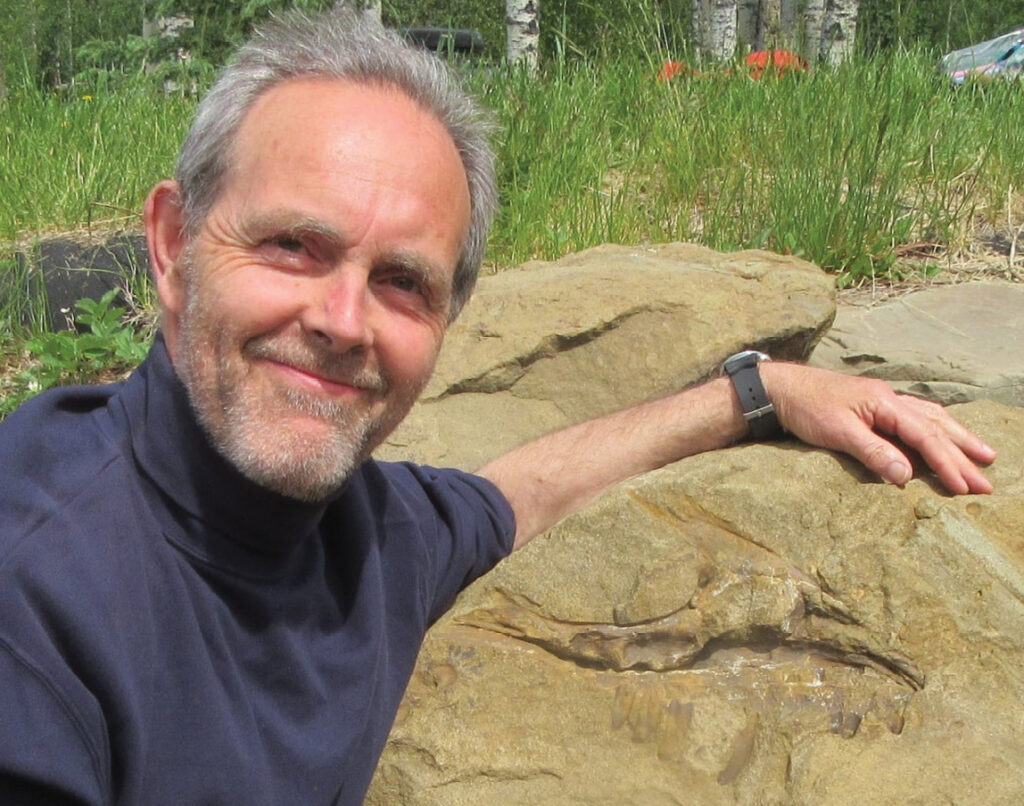

Trent is the publisher of Tumbler RidgeLines.