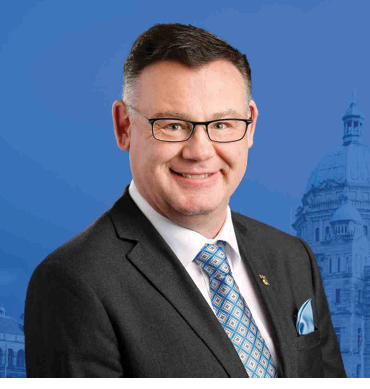
Coming as no surprise, incumbent Larry Neufeld will be returning to Victoria to represent Tumbler Ridge.
Neufeld captured 6,070 votes—or 77.7 percent of the vote, up from his 2022 result of 69.84 percent of the popular vote.
While his percentage is up, total numbers are down, as two years ago, 7,182 people voted for the South Peace Conservative Candidate.
So far, 7,841 people have voted in the South Peace, down from 10,298 two years ago.
While a total number of registered voters hasn’t been released, there were 18,206 in the last election, meaning 56 percent of the population turned out to vote.
If that number were the same this election, only 43 percent of the population turned out to vote.
While the overall numbers are down, Elections BC still hasn’t released a final number of eligible voters, so that number is only speculation.
Indeed, the total number of votes cast is also not final, as mail in ballots, assisted telephone voting ballots, absentee ballots cast at special voting opportunities and absentee ballots cast on final voting day have yet to be counted.
The numbers will be finalized and released in the next couple weeks.
Coming in a distant second place was NDP candidate Marsha Dufresne, with 1,201 votes, or 15.37 percent of the popular vote.
Helen Scott, who was running as unaffiliated, though “endorsed and approved by One BC leader Dallas Brodie,” came in third, with 542 votes, or 6.94 percent.
While Neufeld’s 77.7 percent of the popular vote is impressive, it pales in comparison to Conservative Curtis Whitford, who captured a whopping 85.7 percent of the vote over incumbent Jordan Kealy who is charged with sexual assault.
Provincially, while the numbers going into the election seemed to be tight, the actual results weren’t even close, with the Conservatives being declared victors in 64 ridings, compared to the NDP’s 27 and the Green’s two.
Voting numbers were down across the province.
The number of people who voted in advance was down more than 11 per cent compared to 2024, flying in the face of a two-decade upward trend.
There were more than 891,000 advance votes cast from Friday to Wednesday, representing about 24 per cent of all registered voters.
That compares to more than one million advance votes cast in 2024, when numbers spiked 49 per cent over the previous election.
The total number of people casting ballots fell to under half the eligible voters in the province for the first time, with 48.1 percent of the population voting (though again, results are not final and mail in ballots still need to be counted).
That’s down 10 percent over last election as is worse even than 2020, in the heart of the Covid pandemic.
Lorne Doerkson is the Premier elect for the province. Doerkson is from Williams Lake, and is the first premier elected from the north since Duff Pattullo was elected in 1933. (Dan Miller, from Prince Rupert, served as premier in 1999, but he came into the position after Glen Clark resigned.)
There are potential issues ahead for the Conservatives, though, despite a rather large majority. Doerkson is technically the interim party leader, and, according to the party’s own rules, cannot run as actual leader, and will need to be replaced within a year.
The BC Conservatives have stated they will “pursue the appropriate means under the Party’s Constitution” to make that change, which involves a 2/3 vote of the party members.
It’s a remarkable turnaround for the party who, just days before the election was called, seemed on the cusp of falling apart, with a number of MLAs leaving for CentreBC.
But when the vote was called, all those members returned (except Elenore Sturko, who stayed on as party leader, and placed third in her riding of Surrey South behind the NDP candidate and the winning Conservative candidate), and the party presented a remarkably unified campaign.
The Conservatives promise to reduce the province’s deficit to 10.8 billion buy 2030, with no new taxes.
They also promise to raise BC’s basic personal income tax exemption from $13,216 to $32,000, which they say would cut provincial taxes by on average $1,000 per person.
They promise to finish building the Surrey Hospital and BC Cancer Centre, as well as a new ten lane bridge to replace the Massey Tunnel.
They have promised to scrap the province’s no fault auto insurance model, which the NDP brought in with much fanfare.
Other things on the chopping block are the Declaration on the Rights of Indigenous Peoples Act (DRIPA) and repeal SOGI 123, an inclusive sexual orientation and gender identity initiative used in many schools.
Neufeld has been the shadow minister for Energy for the Conservatives since June. Before that he was shadow minister for LNG and natural gas.
Trent is the publisher of Tumbler RidgeLines.