
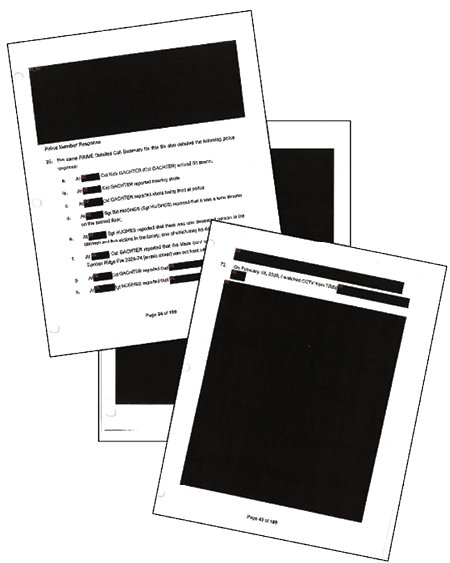
A tranche of documents around the Tumbler Ridge shooting that was acquired by a consortium of Canadian Media outlets and passed on to Tumbler RidgeLines answers some questions about the incident but raises others.
The documents are heavily redacted, including time stamps. This means that questions around the timeline remain unanswered.
While some media have reported that there was a complaint received about an SUV being driven erratically before the reports of shots fired at the school, these complaints appear after the initial report of shots fired at the school and the file number is also later (74, vs 73). Whether this means the notification was received after reports about shots fired, or whether the case files are listed in order of importance is currently unknown.
In an Application for a Warrant to Search, filed by Constable Paquin, he states he has reasonable grounds to believe that two offenses have been committed. The first is murder, contrary to section 235 of the Criminal Code.
The second offence is redacted, and doesn’t appear in later documents.
Also redacted are items that the police were searching for. Four of the six items being sought are mentioned: Human biological substances including but not limited to: blood, hair, fingerprints and human tissue; Firearms, ammunition, spent cartridge casings; Electronic devices, such as computers, cell phones, or tablets, that may belong to Jesse Van Rootselaar and; Documents verifying residency, including but not limited to identification, mail, prescription medications. But again, other information is redacted.
Notably, all witness statements have been redacted.
Previously it had been reported that Van Rootselaar had previous incidents with the RCMP. According to the Information to Obtain requests (ITOs), there were 12 incidents dating back to early 2018. Rootselaar would have been ten at the time. However, what these incidents were have, once again, been redacted.
Some of the redactions seem pro forma. The names of the victims have all been redacted, even though that information was made public within 48 hours of the shooting.
But what was an ITO needed to search the house in the first place, even though it was the scene of a crime? According to the RCMP, ITOs are generally required when investigators are seeking access to places, records, or devices where a person has a reasonable expectation of privacy.
There was no ITO issued for searching the school, because there was no reasonable expectation of privacy where the incident occurred. As a result, a search warrant, and therefore an ITO, was not required for investigators to examine the scene.
“By contrast, a suspect’s residence, personal electronic devices, banking information, medical records, and similar records all carry a reasonable expectation of privacy. Accessing those areas or records generally requires judicial authorization,” says Staff Sergeant Kris Clark, media relations for the BC RCMP.
“Similarly, if a crime occurs in a public place, or within a residence that does not belong to the suspect, a search warrant may not be required for investigators to examine the scene itself. However, if investigators wish to search the suspect’s residence or other private areas where there is a reasonable expectation of privacy, judicial authorization would typically be required.”
Clark says there are some situations where police can enter a residence without a warrant, but only where immediate action is necessary to preserve life, prevent serious injury, or prevent the imminent destruction of evidence.
“If, during such a lawful entry, police observe evidence of an offence in a location where a reasonable expectation of privacy exists, investigators would generally secure the scene, apply for judicial authorization through an ITO, and then re-enter under the authority of that warrant to conduct a full search and seize evidence.”

Trent is the publisher of Tumbler RidgeLines.