
Every four years, members of the UNESCO Global Geopark network re-evaluates the state of the Tumbler Ridge Global Geopark. This is part of the network’s rigorous process, assessing management, geological preservation, visibility, and community networking.
As part of that, a two person team comes here to tour about the Geopark.
This year’s evaluation team was Goran Pavić, Coordinator of the Croatian Geoparks Network and Guy Martini, Treasurer of the Executive Board of the Global Geoparks Network, who helped found and develop the Geopark program.
In their time in Tumbler Ridge, they saw many sites and talked to many people and organizations, including Tumbler RidgeLines.
Pavić says their job is very important, as their job is to make assessments on how the Geopark has been doing, then report back to the Geopark network.
This is his first time in Canada and, he says, the size of the Geopark is staggering. (At 8,478 sq km, the Geopark is about one eighth the size of Croatia. Indeed, says Pavić, his Geopark is only 500 sq km.) “It’s really huge, compared to the size of European Geoparks,” he says.
“We’ve been looking at how the Geopark conducts educational businesses: with kids, with adults and with schools,” he says. “Also we are checking the infrastructure, any new infrastructure builds. We need to see cooperation with local people. We need to see partnership with other institutions. We need to check how Geopark deals with indigenous people, which is very important for the Tumbler Ridge Geopark. There are a lot of things we need to check, and it’s very important to contact with people. Not only with the Geopark staff. but also with the local community and other people to find out where are the problems? How can we help the Geopark?”
He says there is a lot of interaction between the evaluators and the Geopark. “That means we need to understand the situation so we can give them good advice on how to help them to become the better Geopark.”
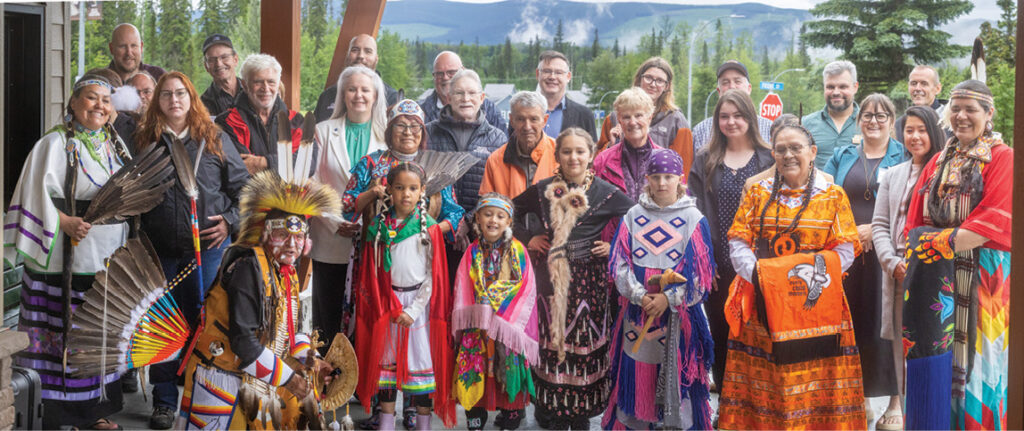
In their time in town, they visited the visitor centre, the museum, and, of course, the new GeoCentre, where members of the community were invited to meet with the evaluators, and members of the Saulteau First Nations came to dance for both the evaluators and the community.
“It’s always important to meet people who are involved in the work of the geopark,” says Pavić. “In this case we wanted to meet more with First Nations because it’s very important for this Geopark. We prepare before we come here; we read all reports. But when you are in the Geopark, you can speak directly with people, it’s very important to talk with people and to get as much more information as possible.”
He says this is the first chance he has had to meet First Nations people. “For me it’s a new experience to meet people who were here 11,000 years ago.”
Martini says this trip has been a “particularly intense and emotional revalidation mission.”
He says this is a land where dinosaurs left their footprints for eternity and where the memory of the Earth is omnipresent. “A territory of breathtaking landscapes, endless mountains, spectacular waterfalls and abundant wildlife, home to cougars, black bears, grizzly bears and hundreds of other animal species.”
But more than that are the people. “This territory is overall remarkable for the presence and history of four Indigenous Peoples – the Dunne-za, Tse’khene, Saulteau and Cree – who have lived in, travelled across, and understood these landscapes for millennia. Their knowledge, traditions, worldview and intimate relationship with nature give this Geopark an absolutely exceptional human, cultural and spiritual dimension.
“Beyond its magnificent landscapes, this Geopark is, above all, a land of humanity. In reality, this immense territory is managed like one large family.
“I would also like to express my deepest gratitude to Dean, Nathan, and all the representatives of the Indigenous Nations who honoured us by sharing their visions and dreams for the future of this territory. Your commitment, openness to dialogue and willingness to build together should make Tumbler Ridge a global example, demonstrating how Indigenous Peoples can be fully involved in the governance of a UNESCO Global Geopark and how, through listening, mutual respect and shared enthusiasm, it is possible to build a territory filled with meaning, history and hope for future generations.”
The two will submit a report to the UNESCO Global Geopark Council, who will meet in September to decide the fate of the Geopark. “We have the green card which means the Geopark can go on for another four years,” says Martini. “A yellow card means you have some problems and we will send back a team of evaluators in two years. Finally, there is a red card which is very bad, and means you are excluded from the network.”
Fortunately, this doesn’t happen very often and only occurs after a long process.
Tumbler Ridge Global Geopark Executive Director Manda Maggs says every team of evaluators is different. “They all have different expertise,” she says. “When they come to visit, they get a deep dive into the things that we do here. And because they come from different geoparks, different backgrounds, they’re able to bring a very different perspective to the table of how our partnerships look and maybe give us some ideas of how we can create better partnerships and do more for our community. They look at the resources we have and they look at what we might be able to do if we had more resources. or where the gaps are. They help us identify things that will help us do the work that we’re doing a lot better. This is just baked into the process of what UNESCO Global Geoparks are and it’s part of the agreement that we have with UNESCO that we will submit to these evaluations in order to maintain the designation.”
Maggs says one of the Geopark’s greatest strengths is the buy-in from the community. “We always want the evaluators to speak to our community members, because they can demonstrate that our community values the Geopark. This is very important. We’re going out and doing a lot of work in the community, building relationships with the Indigenous communities and working on truth and reconciliation in the region and in Canada, not just within the Geopark. We do a lot of work in the community with children, with seniors, with people of all ages. We do signature events throughout the year.”
Maggs says that the experience of showing the park to others helps her as well. “I understand our Geopark a little bit better because I can see it through their eyes and through their experience.”
Trent is the publisher of Tumbler RidgeLines.

