
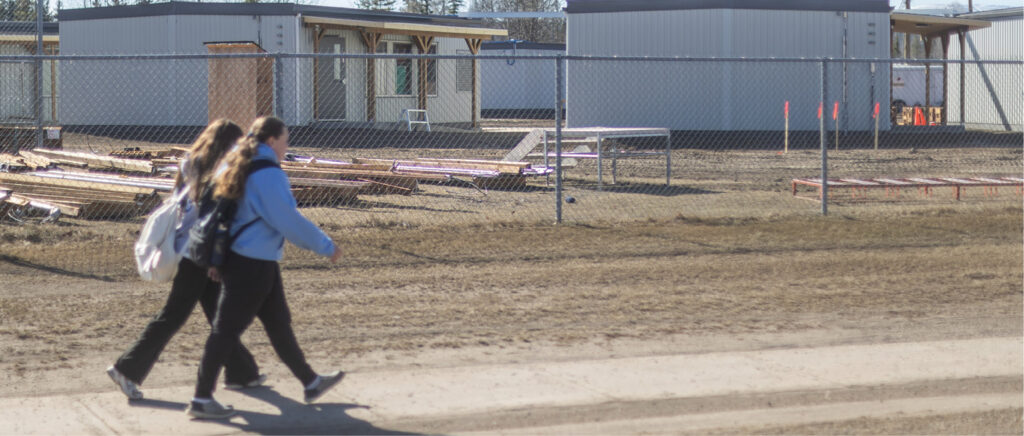
Tumbler Ridge Secondary (TRSS) students have just moved into the new double-wide portables and thoughts are already turning to the a new, purpose built school.
On May 7, the Government of Canada and Province of BC announced plans to build a new secondary school at a new location, with funding from the Province and the Government of Canada, following a school board decision based on consultation with victims’ families, students, teachers, experts and the community.
“Following consultations with victims’ families, students, teachers, experts and community members, the Peace River South (SD59) School Board has requested support from the Province to build a new secondary school at a new location in Tumbler Ridge and to ensure the current school is removed quickly and in a trauma-informed way,” says the release from the Provincial Government. “The Province and Government of Canada will support both the removal of the existing school and the development and construction of the new school.”
There is no word yet on where the school will be located, but will be “informed by trauma-informed community consultations and expert advice, with that feedback guiding a plan that will come back to the community for design consultation later this year.”
The announcement came out the same day as the preliminary consultation report came out from Safer Schools Together (SST).
Over the period of five weeks, SST engaged a broad cross-section of the Tumbler Ridge community, including a confidential online community survey completed by participants across multiple cohorts, including families, school staff, First Nations Rights Holders, emergency responders, municipal representatives, and community members in private and small-group meetings facilitated by senior SST staff, including dedicated sessions with victims’ families and individuals directly exposed to the violence, and a student survey completed by 116 students of the 160 or so students that attend TRSS.
However, this latter was a point of contention at a recent Let’s Talk meeting where SD59 Board Chair Chad Anderson attended. A pair of students—including grad class president Paige Irving—pressed Anderson about the apparent lack of consultation with the students.
“The parent survey was longer than the child’s one. I don’t know if you thought we were incompetent of answering. It’s just weird that you made a survey that was so different from the parents one. I get the parents are important but why are our opinions not as validated as parents?”
Anderson says the student’s responses were valid. “I can assure you that student input is highly valued through this process and as the board looks at the data, I can assure you great emphasis will be on student voices.”
After several exchanges between the two, Irving became visibly frustrated. “I’ve heard you say that you’re confident that you’ve heard people’s voices more times than I’ve heard you say that you’re sorry that you haven’t,” she said to Anderson. “I think it’s embarrassing. I’m sorry, but I’m telling you right now that you’re wrong. You have not heard our voices. I’m not talking for myself; I’m talking for everybody. I haven’t talked to one person in this entire town that has said that their voices were heard. And I’ve talked to a lot of people. I talk to literally everybody that I meet. You haven’t heard us. I’m not talking for myself. And I’m telling you that you’re wrong. I don’t know if you’ve heard that. You’re sitting here and saying confidently that you’ve heard our voices. Instead of saying and trying to defend your point that you’ve already made, why can’t you just accept your wrong? I don’t want to hear you say that you’ve confident with the results. I want you to say that you’ll do better.”
Anderson says he wants people that took part in the process to be assured that “two students tonight don’t have a stronger voice than they did taking part in this process. I want to give them the confidence that we are looking at feedback from all students. We’re happy to make sure that if you did not get an opportunity to participate in that process, that we can do that. But we also want to maintain the confidence of all those people that have been through a traumatic time that took part in this process that their voices will be heard.”
According to the consultation report, there is strong consensus across students, families, and staff that the existing Tumbler Ridge Secondary School building is psychologically unsafe. “Trauma exposure is described as severe and specific, repeatedly tied to particular sensory memories. Participants consistently echoed that learning cannot occur without psychological safety, and forcing return to the school was described not just as harmful but as wrong. Those not directly impacted expressed sympathy for students and staff who were most affected, and there was concern that the impact of traumatic stimuli cannot be reliably predicted. Across cohorts, participants emphasized that students’ voices and lived experiences must remain central to decisions about the future learning environment. This was framed not as a courtesy but as an ethical and trauma-informed necessity: decisions made without students’ meaningful input risk compounding the impact of the tragedy. Participants also recognized that students are affected differently depending on their experiences, and that no single decision can reasonably be expected to meet every student’s needs.”
There were varying views on whether the existing building should be removed, renovated, or preserved, says the report. “Some participants described simply seeing the building as traumatic. Others indicated they might be able to return to a renovated building but worried about what would happen if they were psychologically unable to do so once renovations were complete. Some emphasized that the building must be made completely unrecognizable.”
Because of this, the decision was made to build a new school. That said, concern was also expressed for students who may complete the rest of their high school experience in portables and the potential impact this may have on their educational program.
For example, a school that burned down in Coquitlam in October 2023 is expected to finally be rebuilt by December of next year. That said, two years of that time was spent waiting to secure funding to rebuild, which finally was secured in October of last year, two years after the fire. If timelines are similar for Tumbler Ridge, a new school could conceivably be ready to open by the 2028 school year at the earliest.
This means that there is a heightened sense of urgency about educational disruption during the interim period, with fear of prolonged reliance on portables and concerns particularly acute for students in Grades 10 to 12. “Educational loss was tied to student disengagement and to a loss of independence and potential developmental regression. This was framed as a current concern rather than only a future risk, with concrete examples including single-class schedules, no labs, no gym, and no electives. Participants also raised the risk of families leaving Tumbler Ridge pre-emptively in response to continued disruption.”
And, while it is possible to teach subjects like Math and Science and English and History in a portable, that becomes more difficult for trades, life skills and specialty skills. Participants had near-universal agreement that existing trades, life skills, and specialty spaces and programs are non-negotiable. “Participants drew direct links between these programs and student engagement, mental health regulation, employment pathways, and community identity. There was clear emphasis not only on preservation but on expansion, including dual credit, modern equipment, First Nations-led spaces, and integration with social-emotional learning and trauma recovery. The loss of these spaces and programs would be experienced as punitive.”
Any future school would need to match or exceed the capacity of the existing spaces and programs.
Security was listed as important, but equally important was avoiding excessive, fear-inducing measures. “Participants framed safety as something to be achieved through environmental design and implementation of school safety training, products, and other initiatives.”
The school will be located near the downtown core again. Walkability, winter climate, and the lack of public transit were identified as decisive factors in determining a future site, with central location framed as essential. “Participants emphasized that visibility matters as much as distance, with some respondents describing how they plan their daily routes to avoid seeing the existing building. For some, the desire for a site near the town centre influenced their broader response to whether they wanted a new site at all, as they did not feel another location within walking distance of town was available.”
While the idea of a K-12 school was raised, it was nearly universally opposed, with concerns centred on safety, age separation, and developmental appropriateness. “Participants opposed a combined model because of fears it would compound trauma and concerns about cultural and developmental impacts. Some conditional support for a combined model was expressed, but it was limited and heavily restricted.”
Finally, people recommended that the current school space be used for something life affirming. “Suggestions included gardens, splash parks, sports grounds, and youth-focused spaces, with a clear preference for joyful remembrance over tragedy-focused approaches. Participants opposed somber, static memorials, drawing a clear distinction between meaningful remembrance and retraumatization.”
David Eby says the province will continue to be there to ensure the community has the supports they need. “Building a new school is an important step in providing students and staff a healing and supportive place to learn and work, and is the result of Tumbler Ridge families, BC and Canada standing together for the future of this vital community.”

Trent is the publisher of Tumbler RidgeLines.