
Last Thursday, students at Tumbler Ridge Elementary returned to school for two partial days, on Thursday and Friday, from 10:30 am to 1:00 pm.
This week, they returned to school as normal, starting on Monday. According to School District 59 (SD59), “Gym classes will resume as normal and the gym use during the day will be for elementary students. Students recess and lunch will be at normal times and plans will be made for students to go outside as usual.”
Safety around the construction zone has been carefully planned, with fencing and barriers in place to prevent students from accessing unsafe areas.
To control access to the school, all students will enter and exit through the front door. A team will be at the door to welcome the children. Doors will be locked throughout the day. A phone number will be posted on the front door to access the school office. Guardians and guests wishing to gain access to the school will need to call the number to gain access.
Interior cameras are running in the elementary school, and interior and exterior cameras are being installed.
Mountainview Safety Services have been contracted to maintain a perimeter around the entire school campus, including the elementary school and the phase 1 and phase 2 areas for high school students.
Speaking of high school students, they returned for a partial day on Friday.
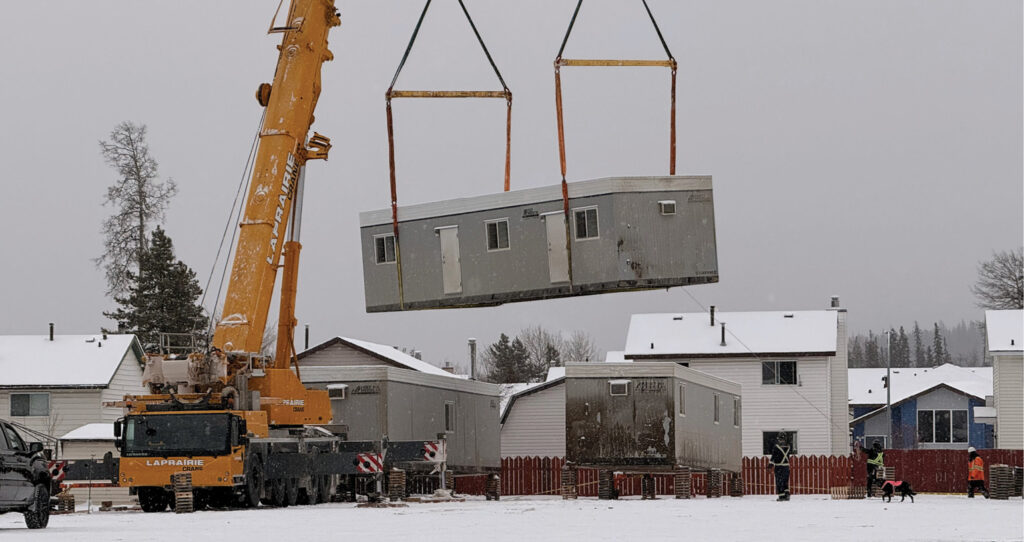
At the moment, high school classes will be in the single-wide portables, located on the field south of the elementary school. This is a temporary location, as work continues on a series of double wide portables on the field east of the elementary school. There is currently no date as to when this slightly more permanent location will be occupied.
The tentative plan this week is for students to be in school from 10am until 2:00 pm, but that, according to SD59, is flexible, and as the paper won’t be back into town until Thursday, falls out of the scope of this update.
Security is a top priority for the school district. Not only will Mountainview Safety Services be maintaining a perimeter around both schools, each portable has two doors, which will remain locked at all times. Students will be allowed in and out at the start and end of each class block and after lunch.
An external camera system will be installed. RCMP has conducted a security review of the area, and the Safer Schools Together (SST) coordinator has worked with the administration around safety planning.
SST is an organization “committed to ending school violence by encouraging school districts to create positive, safe, and caring learning environments for every student, staff, and parent. Using best practices from the field of School Safety and Threat Assessment, SST assists teams in the early identification and intervention of individuals on the pathway to violence. We offer professional training for law enforcement agencies, school districts, and community partners.
As part of that, each portable will have a handheld radio, which have each been assigned to a single channel. If there is a need to call an alarm, all portables will receive the same verbal message simultaneously.
Two SST liaison staff will be on site until spring break as well as a district counseling team.
SD59 Board Chair Chad Anderson says the SST team provided by the province leads the province in terms of physical and online threat assessments. “They have expertise in dealing with this sort of tragedy after it happens. And so their team has been involved in other tragedies such as this across Canada and unfortunately more often in the United States.”
He says SST was on the ground the day after the shooting, with the Associate Deputy Minister of Education. “They’ve been in Tumbler Ridge since then, working on pages and pages of checklists of things that need to be done, people that need to be taken care of and responding to the situation, doing everything possible to bring relief and comfort and making sure that everything that we do moving forward is done in what they call a trauma-informed way.
“We know that a lot of healing has to take place after this. And sometimes people’s best intentions don’t always produce the best results. These folks are trained in caring for people in traumatic situations and they’re very careful at every step to make sure that we weren’t doing more damage after the fact. It might seem like a trivial example, but one example of what they did when they was reuniting staff with their vehicles. They had staff come to Tumbler Ridge Elementary with their keys, and then SST staff went over to Tumbler Ridge Secondary School to collect the vehicles and bring them here to TRE so that staff members from TRSS didn’t have to set foot on the property. There were so many things that they took care of for us in terms of communications and crisis response that were much appreciated.”
The school district is offering options for kids to enroll in Distance Learning (DL) programs with the district. “They can do that for as little or as long as they want,” says Anderson. “They can do DL until they get comfortable with the idea of being back in classrooms. Then kids will be able to transition back. Right now, vast amounts of work have been done to prepare for people coming back to school, to make sure that staff and students and families are going to feel comfortable and safe when they get back to these buildings.”
Some parents, for instance, are happy to see their kids get back to school. “The threat is over,”says one. “And to instill fear of ‘what if’ is going to be detrimental to a child’s health long term. I don’t want them to panic every time something happens in the future.”
On the other hand, there are parents who are not sending their kids back. On Monday morning, some members of the School District invited parents to a meeting before school. In the parking lot, at -15. “It was a complete joke,” says one parent who was there. “I think that the way that they are handling is completely…I don’t want to say wrong, but it feels like it’s going to be business, as usual, and ‘sweep it under the rug as quickly as we can.’ I’m not sending my child back to school until the school district steps up. And they have far from done that.”
And that means communicating.
“All we parents want is some communication, and to have some say in what is happening with our children.”
She says it seemed like they were taking a step in the right direction. “They called every single parent on Wednesday and asked if we had any questions? I said, actually, yes, I have a lot of questions. The person on the phone wasn’t able to answer any of my questions, She said, ‘I will have somebody call you back.’ Nobody ever did.”
But many parents are letting their kids decide. “My kids went to school on Friday, but didn’t want to go today [Monday],” says a third. “They still feel with everything just starting up that they aren’t actually learning, they’re just going to hang out. Which is understandable while this all gets navigated. I don’t truly have an opinion on whether they should go or not, mostly because I have no idea what they are going through. There’s no blueprint for this, so I’m letting them make the decisions that feel right for them, right now. It’s early days still, however. I think things will settle into some sort of rhythm soon.”
Another parent says they’re following the kids’ lead on this. “Our son is eager to go back to school, but our daughter [who was in the same class as many of the kids who were shot] is not there yet. We expect she’ll be back by the end of the week.”
And that’s okay, because not everyone will have the same reaction, says Anderson. “A big focus for us is recognizing that everyone in Tumbler Ridge and in these two schools had a different experience that day, and have different levels of trauma and a different recovery time. For many, recovery won’t always feel linear. Two steps forward, one step back, or maybe it’ll feel like two steps backward, one step forward some days. And we will just have to be patient with people and understanding that is going to be a natural part of that process. There’ll be good days and bad days and we have to be prepared for that so that we can provide a safe environment for students every day.”
At the moment, secondary students are in single wide portables, but work is nearly complete on a group of double wide trailers, which will feel more like classrooms. “We have some of those in Dawson Creek for when a school outgrows its bounds. The double wide portables feel more like a normal classroom dimensions, so they’ll be more comfortable for the medium-term.
And in the long term? Anderson says they’re waiting on guidance from SST. “They are providing that post trauma support, post crisis support. They’re going to do an assessment of the building and what took place there that day and provide guidance as to whether that building could conceivably be repurposed. In some school facilities that have been through these sort of tragedies, sometimes they’re able to shut down a wing or remove a building or there are other remedial steps that can be taken. So we’re waiting for their advice on how to appropriately and thoughtfully and in a trauma-informed way involve the community in decisions about that building.
“We don’t want to do something that pits members of the community against each other on some sort of political debate about a building, just like we don’t want to inflict pain on the community. So SST will give us advice on how best to go forward with that. And obviously the RCMP investigation will provide insights into how to create a safer space.
He says this shooting will have ramifications across the country. “School boards across the country and beyond are naturally going to reconsider everything about school security, but we have to recognize that we do have advanced complex layers of emergency response plans. They are posted in each classroom. The office has staff who are trained in those. Students get lock down and secure and hold drills. We can say with confidence that the lock down drills that our students here in Peace River South have taken part in over the last several years served us well on this most tragic of days. We know that lives were saved because those students knew—as muscle memory—what to do in that crisis. We have these various layers of safety and security that sometimes we forget about, like the VTRA—the Violent Threat Risk Assessment. We have a worrisome online behaviour report. SST is monitoring social media and the web and sometimes district administration will get a report that involves students in our communities and then those get dealt with. Sometimes it’s the RCMP that might be involved, or mental health counseling might be provided but there’s a lot that goes on that I think families should understand about how safety is created in schools. If any advice that comes out the RCMP investigation or the review by SST, you can be confident school boards across the province and the country will be paying close attention and considering those recommendations, if there are any. These are decisions that will have to be discussed and put into place moving forward. They are not snap decisions.
“Obviously in other countries—particularly the one to the south of us—they have moved to metal detectors in some schools. I know that it’s not all schools, but they have different security elements than we have in Canada. I don’t want to predict what those recommendations will be. And I would not be the best one to provide advice on what the best investments in security and safety would be. We need the people that are actually experts to give us advice so we don’t spend money on the wrong things. We want to invest in the things that have value.
“I heard an interview with a survivor of a school shooting that took place I think in the 1950s or 60s. They were in school the next day. There was no counseling support. It was just move on. But that’s not our culture and I think a lot of damage was probably done by that approach in those days and we don’t intend to do that sort of damage to our students and staff. There’s this right approach for this group of people, and a different, but still right approach for this other group of people, and they might not completely sync up.”
As part of providing options, the school is offering Distributed Learning to students, as not everyone will be able to or want to return.
There are two options for students:
Distance Learning: Completing the course fully at home.
Hybrid Learning: Working primarily from home while accessing in person support at the school site as needed.
“We are committed to ensuring that every student has access to flexible, quality learning options as we navigate the coming weeks and months. South Peace Distance Learning (SPDL) is SD59’s distributed learning school, offering ministry approved and accredited programming for students from Kindergarten through Grade 12. All SPDL learning opportunities will be accessible to students in Tumbler Ridge.”
If you are interested in DL, contact Aaron Harper, Principal of South Peace Distributed Learning, at 250-262-6751, to schedule an appointment, or email spdls@sd59.bc.ca.

Trent is the publisher of Tumbler RidgeLines.

